





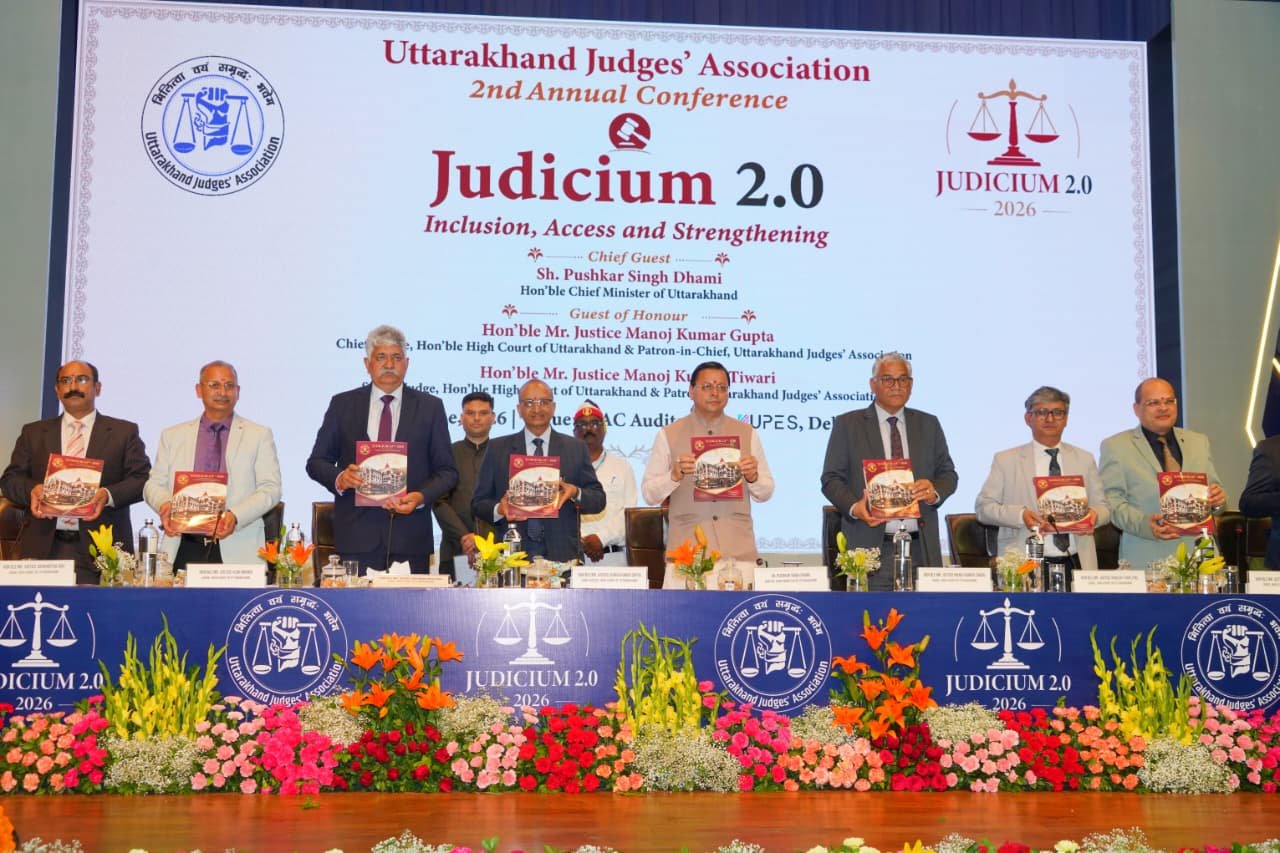
Dehradun: Chief Minister Pushkar Singh Dhami attended “Judicium 2.0: Inclusion, Access, and Strengthening”—the annual conference of the Uttarakhand Judges Association in Dehradun. Speaking on the occasion, the Chief Minister emphasized that making the judicial system more inclusive, accessible, transparent, and effective is the core essence of good governance. He added that ensuring swift and impartial justice reaches every section of society remains one of the topmost priorities of the State Government.
The Chief Minister noted that the conference’s theme focuses on highly critical subjects like inclusivity, easy access to justice, and the strengthening of judicial institutions, which align with the resolve of building a Viksit Bharat (Developed India). He stressed that every section of society must receive equal opportunities and dignity within the judicial framework, and that geographical or economic circumstances should not act as barriers to accessing justice. This is especially vital in a mountainous state like Uttarakhand, where providing simple and accessible justice to people living in remote and far-flung areas is essential.
Furthermore, the CM remarked that the true meaning of justice lies in its fairness and timelines. Unnecessary delays in delivering justice erode public trust; therefore, continuous efforts must be made to make judicial processes more streamlined and time-bound.
Describing the judiciary as a bedrock pillar of democracy, the Chief Minister said it protects the rights of citizens while reinforcing a sense of security and faith in society. The success of the rule of law depends heavily on public confidence in the judiciary, a responsibility that the honorable judges are discharging with great success, he noted.
The Chief Minister highlighted that under the leadership of Prime Minister Shri Narendra Modi, several historic steps have been taken to make the nation’s judicial framework modern, transparent, and tech-enabled. New laws such as the Bharatiya Nyaya Sanhita, Bharatiya Nagarik Suraksha Sanhita, and Bharatiya Sakshya Adhiniyam, alongside digital interventions like e-Courts, the National Judicial Data Grid, digital case management, and video conferencing, have made legal proceedings highly effective.
He added that the State Government is also working round-the-clock to upgrade court infrastructure and reinforce digital courts, e-filing, and virtual hearings. Additionally, long-pending cases are being resolved swiftly and amicably through Revenue Lok Adalats (people’s courts).
Reiterating the state’s stance on law and order, the Chief Minister said the government is working on a strict policy of zero tolerance toward crime. Pointing to the implementation of the anti-copying law, the anti-conversion law, the anti-rioting law, and ongoing crackdowns on corruption and illegal encroachments, he said these measures have significantly strengthened the rule of law in Uttarakhand.
The CM also described the implementation of the Uniform Civil Code (UCC) in the state as a historic step aimed at women’s empowerment and ensuring equal justice for all citizens—a move currently being discussed nationwide. He expressed confidence that the “Judicium 2.0” conference would play a pivotal role in making the judicial framework more inclusive, transparent, and efficient, helping realize the vision of a developed and prosperous Uttarakhand.
On this occasion, the Chief Minister announced an allocation of ₹5 crore toward the welfare fund of the Uttarakhand Judges Association and also released the association’s official souvenir.
On this occasion Chief Justice of the Uttarakhand High Court, Hon’ble Justice Shri Manoj Kumar Gupta, alongside Justice Shri Ravindra Maithani, Justice Shri Rakesh Thapliyal, Justice Shri Alok Mehra, Justice Shri Subhash Upadhyay, Justice Shri Siddharth Sah, the Registrar General of the Uttarakhand High Court Shri Yogesh Kumar Gupta, as well as judges from various courts and other prominent dignitaries were also present.