




Dehradun : On the fifth day of the Uttarakhand State Foundation Day celebrations, the folk culture of the Himalayas had descended onto the stage. In the first session, folk artists from Uttarakhand, along with Ladakh, Tibet, Himachal Pradesh, and Manipur, presented their performances.
The program was inaugurated by former Chief Minister Tirath Singh Rawat by lighting the lamp. He was accompanied by Madhu Bhatt, President of the Uttarakhand Culture and Literature Art Council, Shri Pradeep Joshi, Additional Secretary of Culture Department, and Shri Ashish Kumar, Deputy Director of the Culture Department. The Chief Guest presented shawls and mementos to all the visiting artists.
Pandava and Mask Dances Fill the Atmosphere with Energy
The session began with artists from the Jaagari Cultural Art Stage, Ghat Chamoli, arriving on stage with the sounds of Dhol-Damaun, Mashakbeen, and Bhankore (traditional instruments). The skillful Dhol (drum) playing, Jagar (invocation song) singing, and the artists’ depiction of the Pandavas captivated the audience. Following this, the troupe presented a traditional Mask Dance, whose rhythm, beat, and pace infused life into the program. The group’s leader, Harish Lal, showcased his talent in Dhol playing along with his companions.
Culture of Ladakh Mesmerizes Hearts
The Zobra Dance from Ladakh, a border and high Himalayan region of the country, was a special attraction of the day. In this dance, the Yak, which is the basis of Ladakhi life, was also depicted dancing, providing great entertainment to the audience.
Zobra Dance is a traditional folk dance of Ladakh. It is performed especially during the harvest season. In this, people of the village, particularly men and women, wear traditional attire and dance collectively. The purpose of this dance is to express gratitude towards nature, the gods, and local deities for providing a good harvest. The Zobra dance features slow and rhythmic movements accompanied by the tunes of local instruments like the Dhol (drum) and Surnai (shawm).
Tibetan Students’ Good Luck Dance
Students from the Tibetan Home Foundation, Rajpur Dehradun, presented the Good Luck Dance, which narrates the religious journey of the 14th Dalai Lama. This is a traditional folk dance of Tibet, also known as the Wishing Dance or Good Fortune Dance. It is performed on special occasions—such as the New Year’s Losar festival, harvest time, or the beginning of any auspicious work. Saurabh, a student from the Tibet Home Foundation, introduced the dance, said that the dancers wear colorful traditional attire and dance in a circle to the rhythm of instruments like drums, cymbals, and trumpets. Sometimes, religious symbols and masks are also used, which are symbolic of warding off evil spirits and inviting good luck.
Audience Swings to Manipuri Basant Raslila
Artists led by veteran Manipuri artist Smt. Dhanarani Devi presented the Holi Dance of Krishna and Radha, which is known as Basant Raslila. This dance features the traditional dance of Shri Krishna, Radha, and the Gopis (cowherd girls). It is a heritage of Manipur’s folk culture. The artists’ expressions and costumes captivated the audience.
Play Conveys the Message of Saving the Environment
In the second session of the ceremony, a play was staged under the direction of Dr. Ehsaan Bakhsh of the National School of Drama (NSD). The play was performed by artists trained by Dr. Bakhsh in a five-day workshop.
The story of the play is set in a village in the Kumaon region of the mountains. In the village, the village head’s wife gives birth to a child with horns. Disheartened, the head asks his servant to kill the baby. The plot of the play is woven in such a way that the horned child grows up, gets an education, and returns to the village. Though initially a cause of curiosity, he soon gets involved in the work of saving the greenery in the village. Certain events unfold that lead the village head to try and shoot the horned boy, at which point his servant reveals that this is his own son, whom he had not killed but had left in the jungle. The play highlights the issues of corruption and threats to the environment. The audience widely appreciated the artists’ disciplined acting.
Himalayan Views in the Photo Gallery
A photo exhibition has also been set up at the ceremony by the Uttarakhand Tourism Development Council (UTDC). The theme of this exhibition is “Cultural Heritage and Natural Landscape of Uttarakhand. In this photo gallery there are pictures of, The beautiful views of the Uttarakhand Himalayas, Local temples and public life, Wildlife., Various fairs, festivals, and celebrations.
The exhibition includes excellent photographs from well-known photographers such as Anoop Shah, Umesh Gonga, Rahul Guha, Satish H, Deep Rajwar, and several other notable photographers.
Evening Session
The fifth day’s evening session began with a performance by the artists of the Gorkhali Sudhar Sabha, Dehradun. The performers presented dances based on the diverse cultures of the Gorkha community. Among them, the dances by Poonam Thapa and Aditi Panthi were especially appreciated. Deputy Secretary of Culture Department, Mr. Pradeep Joshi, honored the artists and senior members of the Gorkhali Sudhar Sabha on stage.
Kashmir Vibes on the Santoor
Carrying forward the legacy of the legendary Santoor maestro Pandit Shivkumar Sharma, his son Pandit Rahul Sharma made the stage of Ninad 2025 truly special. The evening began with the traditional lighting of the lamp. Pandit Rahul Sharma shared that the Santoor was originally a folk instrument from Kashmir, and it was his father who introduced it into Indian classical music. He presented a mixed Pahadi Raag that included several folk melodies from the mountains. His Jugalbandi in Teen Taal with renowned tabla player Ojas Adhiya was highly applauded by the audience.
Padma Shri Malini Awasthi began her performance with the devotional song “Mai Vindhyachal Ki Mahima Apaar Ba, Ooncha Darbar Ba.” After that, she mesmerized the audience with a series of her superhit songs including “Ram Ji Ke Bhailen Janamwa,” “Tum Bhool Gaye Humko, Hum Bhoole Nahi Tumko,” “Badariya Jhimmat Aave More Raja,” “Chandni Chhip-Chhip Jaiho Atariya,” “Sejiya Pe Lote Kala Naag,” “Kachori Gali Soon Kaila Balamu,” and “Raliya Bairan Piya Ko Liye Jaye Re.” Her soulful renditions made the audience sway with joy.
I share a deep bond with Uttarakhand”: Malini Awasthi
Padma Shri Malini Awasthi shared that she has a long-standing connection with Uttarakhand. Her elder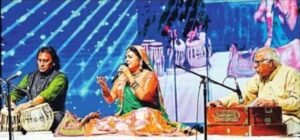 sister’s family lived at FRI in Dehradun, where she spent much of her childhood. After marriage, her husband served as the SDM in Ranikhet, and she spent considerable time there with him. She fondly recalled memories from that period and shared them with the audience. She mentioned that when her husband was transferred, she was gifted a pichora (traditional Kumaoni stole), which she has carefully preserved to this day. She also revealed that she had bought a piece of land in Ranikhet at that time, on which she has now built a house. “Along with Uttar Pradesh, Uttarakhand is also my home,” she said warmly.